
Schedule a Free Consultation  972-905-2170

Understanding the Citizenship Oath of Allegiance
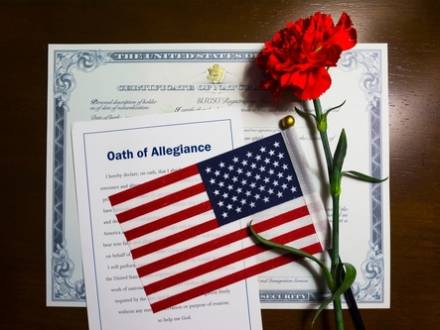 The citizenship oath of allegiance is the final and most important step in becoming a U.S. citizen. It is a public promise made in a ceremony, and it marks the moment a person officially transitions from lawful permanent resident to American citizen.
According to USCIS, the oath of allegiance has led to American citizenship for more than 220 years, dating back to the first naturalization law in 1790. Understanding what the oath says, what it means, and what it requires of you helps you walk into your naturalization ceremony fully prepared. If you are working toward citizenship in 2026, the Dallas, TX U.S. citizenship lawyer at Law Office of Jae Lee is ready to help.
What Is the Oath of Allegiance?
The oath of allegiance is a formal declaration of loyalty to the United States. You make it out loud at a public naturalization ceremony, in front of a USCIS official or a judge. You are not a U.S. citizen until you have taken this oath. Even if USCIS has already approved your application, that approval alone does not make you a citizen. The ceremony and the oath are required.
The oath is codified in Section 337(a) of the Immigration and Nationality Act, or INA. The full text is standardized, meaning every person who naturalizes recites the same words.
What Does the Oath Actually Mean?
The oath has several distinct parts, and each one carries real legal meaning. Breaking it down section by section makes it easier to understand what you are committing to when you raise your right hand.
The first part requires you to renounce all allegiance to any foreign country, government, or ruler. This means you are formally giving up any loyalty you had to your country of origin as a matter of law. It does not mean you have to stop caring about your culture, your family, or your heritage. It means your legal and political loyalty now belongs to the United States alone.
The second part requires you to support and defend the Constitution and laws of the United States against all enemies, foreign and domestic. This is a commitment to uphold the legal foundation of the country.
The third part requires you to bear arms on behalf of the United States if the law requires it, perform noncombatant military service if required, or perform work of national importance under civilian direction if required. These commitments are conditional. They only apply if the law actually calls for them.
The final part states that you are taking the oath freely, without any mental reservation or intention to avoid its obligations. You are making a sincere promise, not just going through the motions.
Can the Oath of Allegiance Be Modified or Waived?
In certain situations, USCIS allows a modification or waiver of the oath. If you have a sincere religious objection to taking an oath or to the phrase "so help me God," you can request to substitute the word "affirm" for "on oath" and omit the religious language. USCIS grants this simply upon your request without requiring documentation.
There are also modifications available for the portions of the oath involving bearing arms or performing military service. If you have a sincere religious objection to participating in combat or in war in any form, you may be able to have those clauses removed from your oath. This requires documented evidence of your religious beliefs and training.
Additionally, USCIS may waive the oath entirely for people who are unable to understand its meaning because of a physical or developmental disability or mental impairment. For children under 14 who are naturalizing, the oath is generally waived because they are considered too young to understand its significance.
What Should You Bring to Your Naturalization Ceremony?
Preparation matters. Here is what you need for your naturalization ceremony:
- Your Form N-445 notice
- Your Permanent Resident Card, which you will turn in
- A valid photo ID
- Any documents USCIS specifically requests in your notice
Do not bring items that are not permitted, and arrive on time. If you cannot attend your scheduled ceremony, contact your local USCIS office as soon as possible to request a new date. Missing more than one ceremony without a valid reason can put your entire application at risk.
Schedule a Free Consultation With Our Plano, TX Immigration Attorney
At Law Office of Jae Lee, our attorney works directly with every client one-on-one, so you always know who is handling your case and where things stand. He understands the immigration journey personally because his own parents went through the process. That perspective shapes the way he approaches every case with genuine care and attention. Whether you are just starting the naturalization process or preparing for your interview, the team at Law Office of Jae Lee can work with you remotely, so distance is never a barrier to getting the help you need.
Call 214-799-5062 today to schedule a free consultation with a Dallas, TX U.S. citizenship lawyer who cares.


From our offices in Dallas and Plano, Texas, we serve clients throughout the surrounding areas including Fort Worth, Irving, Arlington, Farmers Branch, Frisco, Carrollton, Garland, Addison, Richardson, Allen, Murphy, Wylie, McKinney, Dallas County, Collin County, Denton County, and all of Northeastern Texas.
Results listed are not a guarantee or indication of future case results.
Contact Our Firm
 The use of the Internet or this form for communication with the firm or any individual member of the firm does not establish an attorney-client relationship. Confidential or time-sensitive information should not be sent through this form.
I have read and understand the Disclaimer and Privacy Policy.